You have 0 items in your cart
Choosing hotel towels may seem like a simple purchasing decision. But when you are buying hundreds or thousands of towels, the supplier you choose can matter just as much as the towel itself.
The lowest-priced supplier may look attractive on a spreadsheet. But if the towels lose softness quickly, shrink after repeated washes, arrive inconsistently, or need replacing sooner than expected, that “saving” can become an expensive mistake.
For hotels, resorts, spas, motels, and other hospitality businesses, towels are part of the guest experience. Guests touch them every day, which means their softness, absorbency, cleanliness, and overall feel can influence how they perceive your property.
So, how do you compare hotel towel suppliers properly?
The answer is to look beyond price and compare quality, specifications, consistency, durability, service, delivery, and total cost of ownership.
This guide explains what to look for when choosing a hotel towel supplier and how to make a purchasing decision that works for both your guests and your operating budget.
Why Does Choosing the Right Hotel Towel Supplier Matter?
Hotel towels go through conditions that ordinary household towels rarely experience.
They are repeatedly:
- Used by different guests
- Washed at commercial scale
- Exposed to detergents and cleaning chemicals
- Dried at high temperatures
- Folded and handled frequently
- Replaced when stains, fraying, or damage become noticeable
That makes durability particularly important.
A towel can feel luxurious when it is brand new but perform poorly after repeated commercial laundering. For hospitality buyers, the better question isn’t simply, “How soft is this towel?”
It is:
“How well will this towel perform throughout its usable life?”
A reliable hotel towel supplier should help you balance guest comfort with operational requirements such as laundering, replacement frequency, inventory management, and cost.
What Should You Compare Between Hotel Towel Suppliers?
Comparing suppliers becomes much easier when you use the same criteria for every company.
Here are some of the most important factors to evaluate:
| Comparison Factor | What to Look For |
| Material | Cotton type, blend and fibre quality |
| GSM | Weight and intended hospitality application |
| Absorbency | How effectively the towel absorbs moisture |
| Softness | Initial feel and softness after repeated washing |
| Durability | Resistance to thinning, fraying and wear |
| Construction | Stitching, hems and overall finishing |
| Shrinkage | Size retention after commercial laundering |
| Consistency | Similar quality across repeat and bulk orders |
| Product Range | Bath towels, hand towels, washcloths, bath mats, etc. |
| Pricing | Unit price, volume pricing and total cost |
| MOQ | Minimum order requirements |
| Availability | Stock levels and replenishment capability |
| Delivery | Lead times and shipping reliability |
| Service | Responsiveness and hospitality knowledge |
Don’t judge suppliers based on a single factor. The best value usually comes from the supplier that performs well across the entire purchasing cycle.
Compare Towel Material and Cotton Quality:
Start with what the towel is actually made from.
100% cotton hotel towels are widely used because cotton naturally provides a desirable combination of softness, absorbency, comfort, and durability.
However, seeing “100% cotton” on two product descriptions does not necessarily mean the towels will perform identically.
Fibre quality, yarn construction, weaving, finishing, and manufacturing standards can all affect the final product.
When talking with a supplier, ask:
- What material is used?
- Is the towel 100% cotton or a blend?
- What type of yarn is used?
- Is the towel designed specifically for hospitality use?
- How does it perform after repeated commercial washing?
A knowledgeable supplier should be able to explain the product rather than simply give you a price.
Compare GSM but Don’t Use GSM Alone:
GSM stands for grams per square metre and describes the weight of towel fabric.
Generally, higher-GSM towels feel thicker and more substantial, while lower-GSM towels tend to be lighter and quicker to wash and dry.
A simplified comparison looks like this:
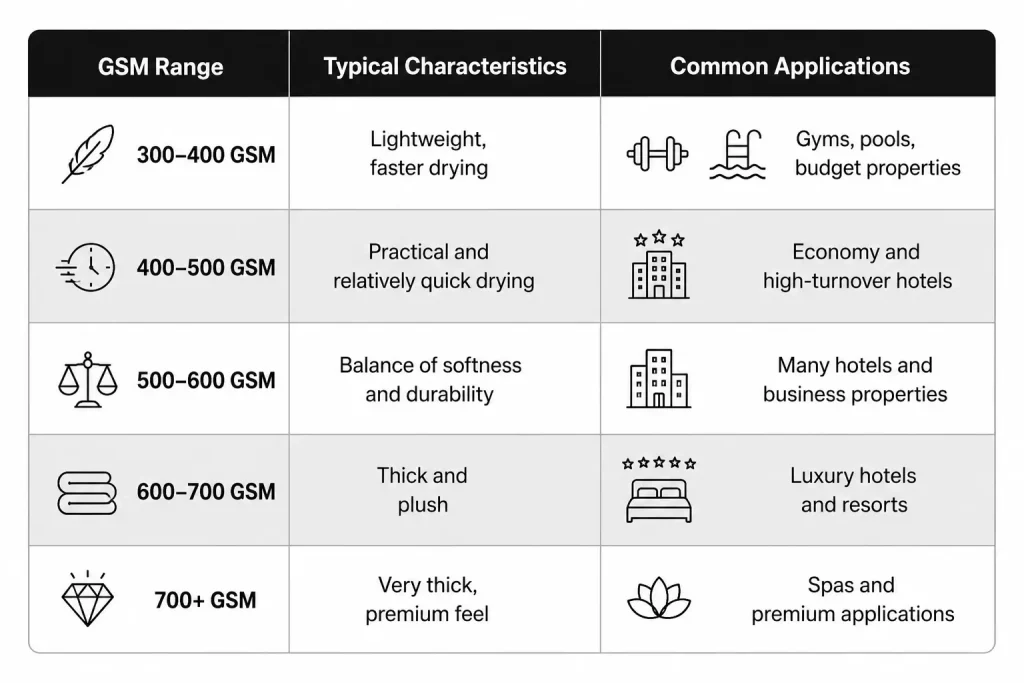
The mistake is assuming that higher GSM automatically means better quality.
It doesn’t.
A well-constructed 500 GSM towel may provide better long-term value than a poorly manufactured 650 GSM towel.
GSM should therefore be compared alongside cotton quality, absorbency, construction, drying time, and durability.
Ask for Samples Before Placing a Bulk Order:
Never rely entirely on online photos.
Product photography cannot tell you how absorbent a towel is, how strong its stitching feels, or what happens after laundering.
Ask potential hotel towel suppliers for samples whenever possible.
When the samples arrive, inspect:
- Overall softness
- Thickness
- Weight
- Stitching
- Hems
- Loose threads
- Dimensions
- Absorbency
- Colour consistency
- Overall finishing
But don’t stop there.
Wash the Samples:
A new towel is only the starting point.
Run samples through a laundering process that resembles your property’s normal routine. If possible, test them across multiple wash-and-dry cycles.
Then compare them again.
Look for:
- Shrinkage
- Loss of softness
- Loose stitching
- Fraying
- Distortion
- Reduced absorbency
- Excessive lint
- Changes in appearance
This gives you a much more realistic picture of how the towels may perform in hotel operations.
Compare Durability, Not Just Initial Softness:
A towel that feels incredibly soft out of the package can make a strong first impression. But hotels don’t use towels once.
Commercial towels may go through frequent laundering, making long-term durability essential.
Pay close attention to areas where towels commonly begin to fail, including:
- Edges
- Hems
- Decorative borders
- Seams
- High-friction areas
Ask suppliers whether their products are designed for commercial or hospitality laundering.
If a slightly more expensive towel lasts considerably longer, it may ultimately be the more economical choice.
Calculate the Total Cost of Ownership:
One of the biggest mistakes hotel buyers can make is comparing suppliers only by unit price.
Imagine two suppliers:
Supplier A: $4.00 per towel
Supplier B: $4.80 per towel
Supplier A appears cheaper.
But suppose Supplier A’s towels need replacing considerably sooner because they thin, fray, or lose their guest-ready appearance.
Supplier B could ultimately cost less over time.
A better purchasing equation is:
Total towel cost = Purchase price + laundering impact + replacement frequency + operational costs
This is why hospitality procurement should focus on cost per use, not simply cost per towel.
Ask Yourself:
How many useful guest cycles are you getting for every dollar spent?
That question can reveal value that the initial purchase price hides.
Compare Absorbency and Drying Performance:
Guests expect towels to absorb water effectively.
But hotels also need towels to move efficiently through laundry operations.
Very heavy towels can feel luxurious, but they may also require:
- More water during washing
- Longer drying times
- More energy
- Greater laundry capacity
This doesn’t mean hotels should always buy lighter towels. It means towel weight should match the property’s operating model.
A luxury resort may prioritize plushness.
A high-turnover business hotel may prefer a balance between comfort and laundry efficiency.
A gym or pool facility may prioritize quick drying.
The right supplier should offer options suitable for different hospitality environments rather than recommending the same towel to every buyer.
Check Product Consistency Across Bulk Orders:
Consistency becomes especially important when buying towels in volume.
Imagine receiving 500 towels today and ordering another 500 six months later, only to discover that the new batch feels noticeably different.
That can create an inconsistent guest experience and make linen inventory harder to manage.
Ask potential suppliers:
- Can you maintain consistent specifications?
- Are the same product lines regularly stocked?
- How are variations between production batches handled?
- Can you reorder the same towel later?
Reliable repeat ordering is particularly valuable for hotels that replace linen gradually throughout the year.
Review the Supplier’s Hospitality Product Range:
A supplier with a broad hospitality textile selection can simplify procurement.
Instead of managing multiple vendors for different products, you may be able to source:
- Bath towels
- Hand towels
- Face cloths or washcloths
- Bath mats
- Pool towels
- Spa towels
- Bed linens
- Other hospitality textiles
This can reduce administrative work and make it easier to maintain consistent quality standards across your property.
It can also help when expanding, renovating, opening another location, or replacing multiple linen categories at once.
Compare Minimum Order Quantities and Bulk Pricing:
Before selecting a wholesale hotel towel supplier, understand exactly how its pricing works.
Ask about:
- Minimum order quantities
- Case quantities
- Volume discounts
- Wholesale pricing
- Shipping charges
- Sample costs
- Custom order requirements
- Payment terms
- Reordering requirements
The cheapest advertised price isn’t necessarily the price your hotel will actually pay.
Compare the landed cost of the order whenever possible.
That means accounting for the towels themselves plus shipping and any other relevant purchasing expenses.
Evaluate Inventory Availability and Lead Times:
Hotels cannot afford to discover that an essential towel is unavailable only after inventory has already dropped to a critical level.
Ask suppliers about:
Stock availability: Are core products normally kept in stock?
Lead times: How quickly can regular orders be processed?
Large-volume capacity: Can the supplier handle bigger orders when necessary?
Replenishment: Can you easily reorder the same product?
Communication: Will the supplier alert you when there are delays or stock issues?
Reliable supply can be just as important as product quality.
Check the Supplier’s Hospitality Experience:
Hospitality purchasing is different from ordinary retail towel shopping.
A supplier familiar with hotels should understand concerns such as:
- Frequent commercial laundering
- Guest expectations
- Linen replacement cycles
- Bulk purchasing
- Housekeeping operations
- Laundry efficiency
- Stock replenishment
- Different towel requirements across hotel categories
Ask how long the supplier has worked with hospitality businesses and what types of properties it typically serves.
Experience doesn’t automatically guarantee quality, but relevant industry knowledge can make the purchasing process much easier.
Compare Customer Service and Responsiveness:
You may not think much about customer service when everything is running smoothly.
It becomes important when:
- An order is delayed
- A product is unavailable
- You need a large quantity quickly
- Specifications need clarification
- There is an issue with an order
- You need help choosing between towel options
Pay attention to the supplier’s responsiveness before you buy.
If getting basic product information is difficult during the sales process, support may not improve after the order is placed.
A good supplier should make procurement simpler—not add another operational headache.
Ask About Certifications and Product Standards:
Depending on your hotel’s procurement policies, location, or sustainability goals, certifications may also matter.
Ask suppliers whether relevant products have documentation covering areas such as:
- Textile safety
- Manufacturing standards
- Material composition
- Environmental standards
- Responsible sourcing
Don’t accept vague claims such as “eco-friendly” or “premium certified.”
Ask exactly what certification or standard applies and which organization issued it.
That makes supplier comparisons much more objective.
Create a Hotel Towel Supplier Scorecard:
When comparing several suppliers, avoid making the final decision from memory.
Create a simple scorecard.
Rate each supplier from 1–5 across categories such as:
| Criteria | Suggested Weight |
| Towel Quality | 20% |
| Durability | 20% |
| Price & Total Cost | 15% |
| Consistency | 10% |
| Availability | 10% |
| Delivery Reliability | 10% |
| Product Range | 5% |
| Hospitality Experience | 5% |
| Customer Service | 5% |
You can adjust the percentages based on your property’s priorities.
For example, a luxury resort might give more weight to softness and guest feel, while a high-volume hotel may prioritize durability, drying efficiency, and replacement cost.
A scorecard prevents one attractive factor usually price from dominating the entire purchasing decision.
Red Flags to Watch for When Comparing Towel Suppliers:
Not every supplier that offers an attractive quote will be a good long-term fit.
Be cautious if a supplier:
- Cannot provide clear towel specifications
- Avoids answering questions about GSM or materials
- Offers unusually low prices without explaining quality
- Cannot provide samples
- Has inconsistent sizing or specifications
- Cannot explain expected commercial performance
- Has unpredictable inventory
- Provides unclear delivery timelines
- Is difficult to contact
- Makes unsupported quality or sustainability claims
A cheap towel becomes expensive very quickly if you have to replace it repeatedly.
Local vs Overseas Hotel Towel Suppliers: Which Is Better?
Both options can make sense depending on your purchasing requirements.
| Factor | Local/Domestic Supplier | Overseas Supplier |
| Lead Time | Often shorter | Often longer |
| Minimum Orders | May be more flexible | Can be higher |
| Communication | Generally easier | Can vary |
| Freight Complexity | Lower | Higher |
| Large-Volume Pricing | Competitive | Can be highly competitive |
| Custom Manufacturing | Varies | Often available at scale |
| Replenishment | Often easier | Requires more planning |
Large hotel groups with predictable demand may benefit from direct overseas sourcing.
Smaller hotels or businesses that value faster replenishment and lower purchasing complexity may find a domestic hotel towel supplier in Canada more practical.
The right choice depends on volume, storage capacity, cash flow, lead times, and how predictable your linen usage is.
Also Read: The Benefits of Buying Bedding in Bulk from a Wholesale Supplier
What Questions Should You Ask a Hotel Towel Supplier?
Before requesting a final quote, ask these questions:
- What material are the towels made from?
- What is the GSM?
- What are the exact towel dimensions?
- Are they designed for commercial hospitality use?
- Can you provide samples?
- What are your minimum order quantities?
- Do you offer volume pricing?
- How consistent are repeat orders?
- What are typical lead times?
- Are these products normally kept in stock?
- What happens if there is a quality issue?
- What are the shipping costs?
- Do you offer other hospitality linens?
- Are relevant certifications available?
- How quickly can you replenish an existing order?
The answers make it much easier to compare suppliers on equal terms.
How Do You Choose the Best Hotel Towel Supplier?
There is no single towel supplier that is automatically best for every hotel.
The right supplier is the one that best matches your property’s priorities.
A luxury hotel may prioritize plushness and presentation. A busy urban property may place more emphasis on durability and laundry efficiency. A resort may need bath, pool, and spa towels from one reliable source.
The strongest purchasing decision therefore balances four things:
Guest experience + durability + operational efficiency + total cost
When those four factors work together, towels stop being just another expense and become a better-managed part of your hospitality operation.
Also Read: Luxury Hotel Bedding Suppliers in Canada
Choose Hotel Towels With Long-Term Value in Mind
The best hotel towel isn’t necessarily the cheapest or the thickest.
It is the towel that delivers the right guest experience while continuing to perform through demanding hospitality use.
When comparing suppliers, evaluate samples, GSM, materials, construction, durability, availability, service, lead times, and total ownership cost—not just the initial quote.
If you’re looking for hotel towels in Canada, bulk hospitality towels, or a reliable hotel towel supplier in Canada, Cotton House offers hospitality textile solutions designed to help hotels balance guest comfort, quality, and everyday operational needs.
Upgrade Your Hotel Linens Today.
Frequently Asked Questions
What should I look for in a hotel towel supplier?
Look at towel material, GSM, absorbency, durability, construction, consistency, pricing, minimum order quantities, stock availability, delivery times, and customer service. Whenever possible, test samples before making a large purchase.
What GSM is best for hotel towels?
Many hotels choose towels around 500–600 GSM because this range can provide a practical balance between softness, absorbency, durability, and laundering efficiency. Luxury properties may prefer heavier towels, while gyms, pools, and high-turnover environments may benefit from lighter options.
Should hotels buy towels based on price or quality?
Hotels should consider both, but the lowest unit price should not be the deciding factor. A higher-quality towel that remains usable for longer can deliver a lower cost per use, making it more economical over its lifecycle.
Should I request towel samples before ordering in bulk?
Yes. Samples allow you to evaluate softness, absorbency, dimensions, stitching, construction, shrinkage, and performance after laundering. Testing samples before placing a large order can significantly reduce purchasing risk.