You have 0 items in your cart
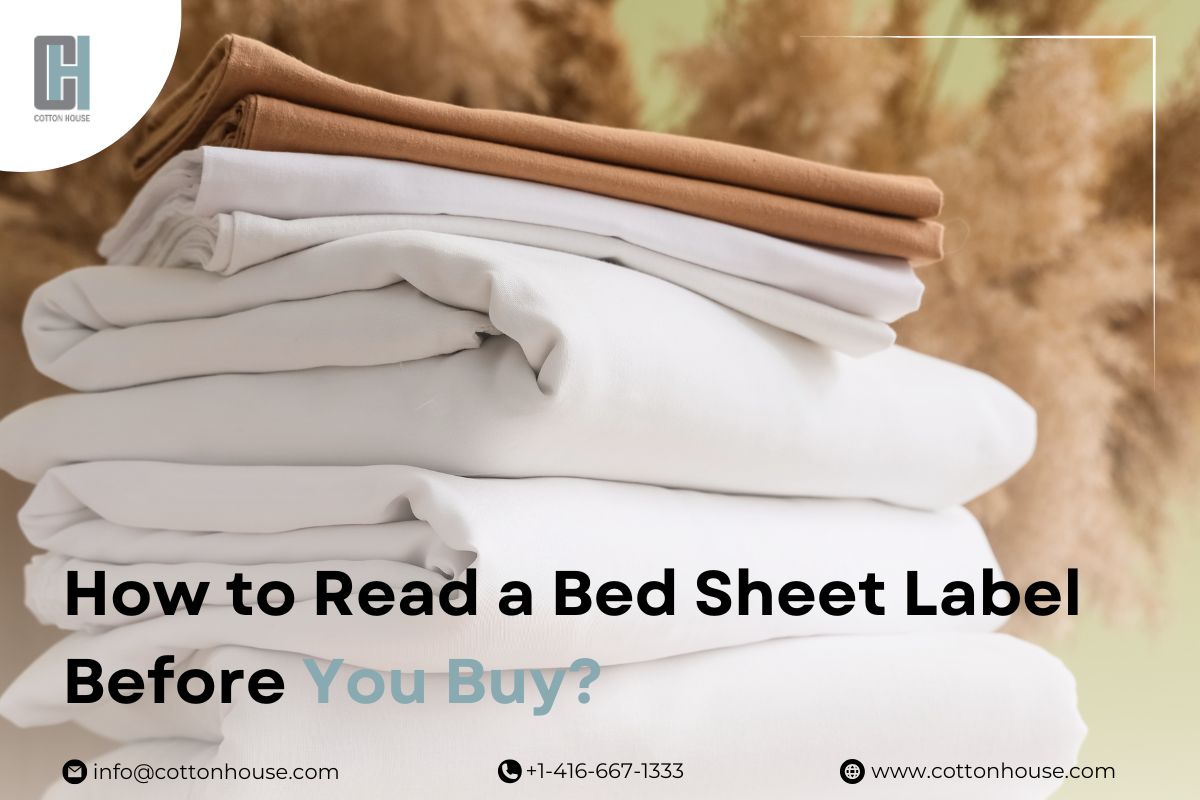
Beautiful packaging can catch your eye. A high thread count can sound impressive. But neither tells you whether those sheets will fit your mattress or feel comfortable through the night.
Before you buy, take a closer look at the details.
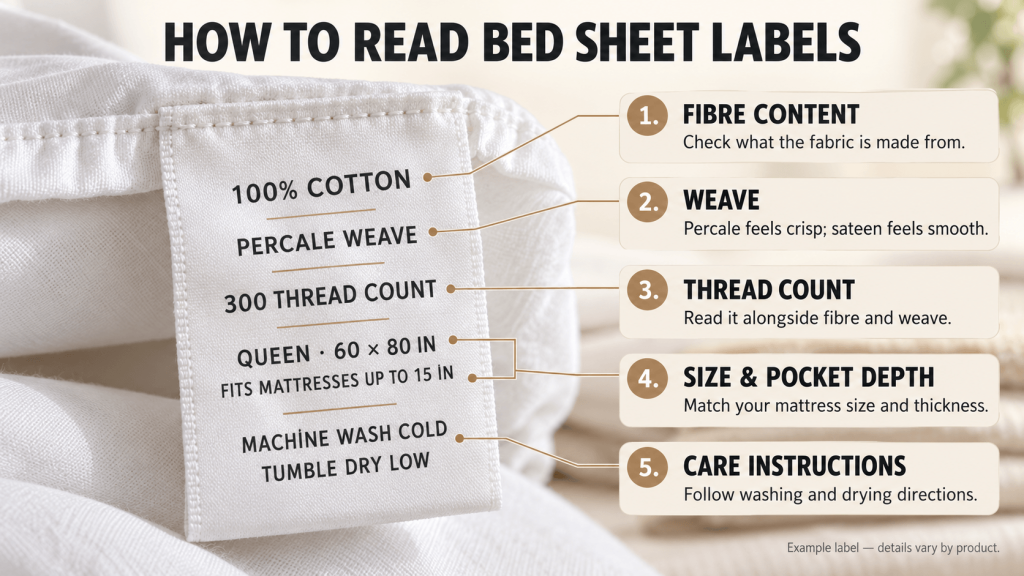
To read a bed sheet label, check the fabric composition, weave, thread count, sheet dimensions, fitted sheet pocket depth and care instructions. Then confirm which pieces are included. Together, these details help you choose sheets that suit your bed, comfort preferences and laundry routine.
Some information appears on the sewn-in label. Other details may be on the packaging or online product page. Here is what to look for and what it means.
Start With the Fabric Composition
The fabric composition tells you what the sheet is made from. It is one of the most useful details to check first.
Look for clear fibre names and percentages, such as:
- 100% cotton
- 60% cotton, 40% polyester
- 100% polyester
- 100% linen
Descriptions such as “cotton-rich,” “silky soft” and “premium bedding” do not provide the same information.
For example, cotton-rich sheets may contain polyester. That blend could suit your needs, but you should know the proportions before buying.
Cotton vs Polyester Sheets: What Should You Know?
Your choice should reflect how you sleep and how much maintenance you prefer.
| Fabric | Common characteristics | What to consider |
| 100% cotton | Absorbent and often breathable | Can wrinkle; follow the care instructions |
| Cotton-polyester blend | Often less prone to wrinkling | Check the exact fibre percentages |
| Polyester microfibre | Often smooth and easy to care for | May feel warmer or less absorbent than cotton |
| Linen | Often airy, with a textured feel | Usually has a naturally creased appearance |
These are general tendencies. Yarn, construction and finishing can change how a particular sheet feels.
Read the composition before relying on the description on the front of the package.
Check the Weave to Understand the Feel
The fibre tells you what the sheet contains. The weave tells you how the threads are arranged.
That is why two sets of cotton bed sheets can feel different even when their fibre content is identical.
Percale Sheets: Crisp and Matte
Percale uses a simple one-over, one-under weave. It generally creates a crisp feel and a matte appearance.
If you prefer bedding that feels fresh and light rather than silky, cotton percale is worth considering.
Sateen Sheets: Smooth With a Subtle Sheen
Sateen has longer threads floating across the fabric surface. This gives it a smoother appearance and often a more flowing drape.
Compared with similar cotton percale sheets, sateen may feel fuller and warmer. The actual result depends on the fabric’s weight and construction.
Jersey Sheets: Soft and Stretchy
Jersey is knitted rather than woven. It often has a relaxed, T-shirt-like feel with some stretch.
A woven-fabric thread count is not a useful way to judge knitted jersey sheets.
When comparing percale vs sateen sheets, start with the feel you enjoy. Then check the fibre content, because the weave name alone does not tell you what the fabric is made from.
Read Thread Count Alongside the Fabric Details
Thread count is the total number of threads running lengthwise and widthwise within one square inch of woven fabric.
For example, 100 threads in one direction and 100 in the other produce a thread count of 200.
On a label, this may appear as:
- 300 thread count
- 300 TC
- TC-300
Does a Higher Thread Count Mean Better Sheets?
Not automatically.
Thread count does not tell you everything about softness, breathability or durability. Those qualities also depend on the fibre, yarn, weave and finishing.
A high number should not distract you from missing information about the material or fit.
Also Read: Do Cooling Bed Sheets Lose Their Cooling Effect Over Time?
What Is the Best Thread Count for Sheets?
There is no single best thread count for every fabric and sleeping preference.
Use it to compare otherwise similar woven sheets. Comparing two cotton percale sets is more useful than comparing cotton percale with polyester microfibre or knitted jersey.
A sensible buying order is:
- Choose the fibre you prefer.
- Look for a suitable weave.
- Confirm the fit.
- Consider thread count alongside those details.
This gives you a clearer picture than shopping by thread count alone.
Understand Single-Ply and Multi-Ply Yarn
Some product descriptions mention single-ply or multi-ply yarn.
Ply refers to the number of strands twisted together to make a yarn.
| Term | Meaning |
| Single-ply | One strand forms the yarn |
| Two-ply | Two strands are twisted together |
| Multi-ply | Two or more strands form the yarn |
Multi-ply fabric is not automatically poor quality. However, thread count claims can become confusing if individual plies are counted as separate threads.
If a very high thread count is the main selling point, look for an explanation of the yarn construction. Ask the seller how the count was calculated if the description is unclear.
A large number is more useful when it comes with clear fabric specifications.
Check Sheet Dimensions Before the Size Name
A label saying “queen” or “king” is only the starting point.
Sheet dimensions can vary between brands and markets. Mattress sizes can also differ between countries.
Measure your mattress before buying:
- Width: From one side to the other.
- Length: From the head to the foot.
- Height: Including any topper underneath the fitted sheet.
Compare those measurements with the product’s actual dimensions.
For flat sheets, check that there is enough fabric for your preferred coverage and tuck-in allowance. For pillowcases, compare their measurements with your pillows.
Do not assume that every queen sheet set will fit every queen mattress in the same way.
Pay Attention to Fitted Sheet Pocket Depth
Fitted sheet pocket depth is especially important if you have a thick mattress or use a topper.
It describes the depth of the sheet’s corners. A product listing may also state the maximum mattress height the fitted sheet is designed to accommodate.
For example:
- Mattress height: 12 inches
- Topper height: 2 inches
- Total height to accommodate: 14 inches
Check the manufacturer’s stated fit range against that combined height.
“Deep pocket” and “extra deep pocket” are not enough on their own. Look for a measurement.
Also check whether the listing describes the corner depth or the maximum supported mattress height. Those details are not always presented in the same way.
A good fit depends on the overall dimensions, elastic and construction as well as pocket depth.
Read the Bed Sheet Care Instructions
Comfort matters, but so does being able to care for the sheets easily.
Before buying, check:
- Whether machine washing is permitted.
- The washing temperature.
- Whether tumble drying is allowed.
- Any restrictions on bleach.
- Recommended ironing settings.
If you use a dryer for most laundry, a sheet that requires line drying may be inconvenient. If you dislike ironing, consider how much wrinkling you are comfortable with.
What Do Bed Sheet Care Symbols Mean?
| Symbol description | What it refers to |
| Wash tub | Washing instructions |
| Number inside a wash tub | Maximum washing temperature in Celsius under the GINETEX system |
| Triangle | Bleaching instructions |
| Square with a circle inside | Tumble drying |
| Iron | Ironing instructions |
| Cross through a symbol | Do not use that treatment |
Dots, bars and other markings add instructions, so read the complete symbol rather than just its basic shape.
Always follow the guidance for the specific sheet set. Two products with the same fibre content may have different care instructions.
Look Closely at Certifications and Quality Claims
Labels may include certification logos or descriptions such as:
- Organic
- Egyptian cotton
- Hotel-quality
- Wrinkle-resistant
- Tested for harmful substances
These claims describe different things. They should not be treated as interchangeable signs of quality.
For instance, OEKO-TEX STANDARD 100 concerns testing textiles for harmful substances against the standard’s requirements. It does not, by itself, mean the sheet is organic or guarantee softness.
If a certification matters to you, look for the exact standard name and verifiable certificate details.
Likewise, “made in” identifies manufacturing origin. It does not necessarily identify where the cotton was grown.
Specific information helps you make a more informed choice than broad phrases such as “luxury quality.”
Confirm What the Sheet Set Includes
Before comparing prices, compare the contents.
A sheet set may include:
- One fitted sheet.
- One flat sheet.
- One or more pillowcases.
However, some sets do not include a flat sheet, and the number of pillowcases may vary by bed size.
Check the size of every item too. A king sheet set may include pillowcases that do not suit the pillows you currently use.
Pillowcases and decorative pillow shams are also different items. Read the contents carefully so you know what you are receiving.
How to Interpret a Bed Sheet Label: A Simple Example
Imagine a product description says:
100% cotton | 300 TC | Percale | Queen | Fits mattresses up to 15 inches | Four-piece set
Here is how to read it:
| Label detail | What it tells you |
| 100% cotton | The stated fibre composition is cotton |
| 300 TC | The stated thread count is 300 |
| Percale | Expect a generally crisp, matte fabric |
| Queen | Check the actual dimensions against your mattress |
| Fits up to 15 inches | Compare with your mattress and topper height |
| Four-piece set | Confirm which four items are included |
This is an illustrative example, not a Cotton House product specification.
You would still need to check the care instructions, pillowcase dimensions and full set contents before buying.
Your Quick Bed Sheet Buying Checklist
Before adding sheets to your cart, ask:
- Is the fibre composition clearly stated?
- Does the weave suit the feel I prefer?
- Have I considered more than the thread count?
- Do the sheet dimensions match my mattress?
- Will the fitted sheet accommodate my topper?
- Can I follow the washing and drying instructions?
- Does the set contain the pieces I need?
These checks take only a few minutes. They can help you avoid sheets that look appealing in the package but feel uncomfortable or fit poorly at home.
Choose Sheets With Confidence at Cotton House
The right bed sheets should feel comfortable, fit properly and work with your everyday routine.
Start with fabric composition and weave. Confirm dimensions and pocket depth. Then check thread count, care instructions and set contents.
Explore Cotton House’s sheet sets and compare the product details to find bedding that suits your bed and your comfort preferences.
Explore Cotton House Sheet Sets
Frequently Asked Questions
What Should I Check First on a Bed Sheet Label?
Start with fibre composition. Then check the weave, dimensions, fitted sheet pocket depth, thread count and care instructions. Confirm the set contents before buying.
Does “Cotton-Rich” Mean 100% Cotton?
No. Cotton-rich sheets may contain other fibres, such as polyester. Read the fibre percentages to understand the actual composition.
Is Thread Count More Important Than Fabric?
Thread count should be considered alongside fabric and weave. It cannot tell you on its own whether a sheet will feel soft, breathable or durable.
How Do I Know Whether a Fitted Sheet Will Fit?
Measure your mattress width, length and total height, including any topper. Compare those measurements with the sheet dimensions and the manufacturer’s stated mattress-depth range.